When does birth begin?
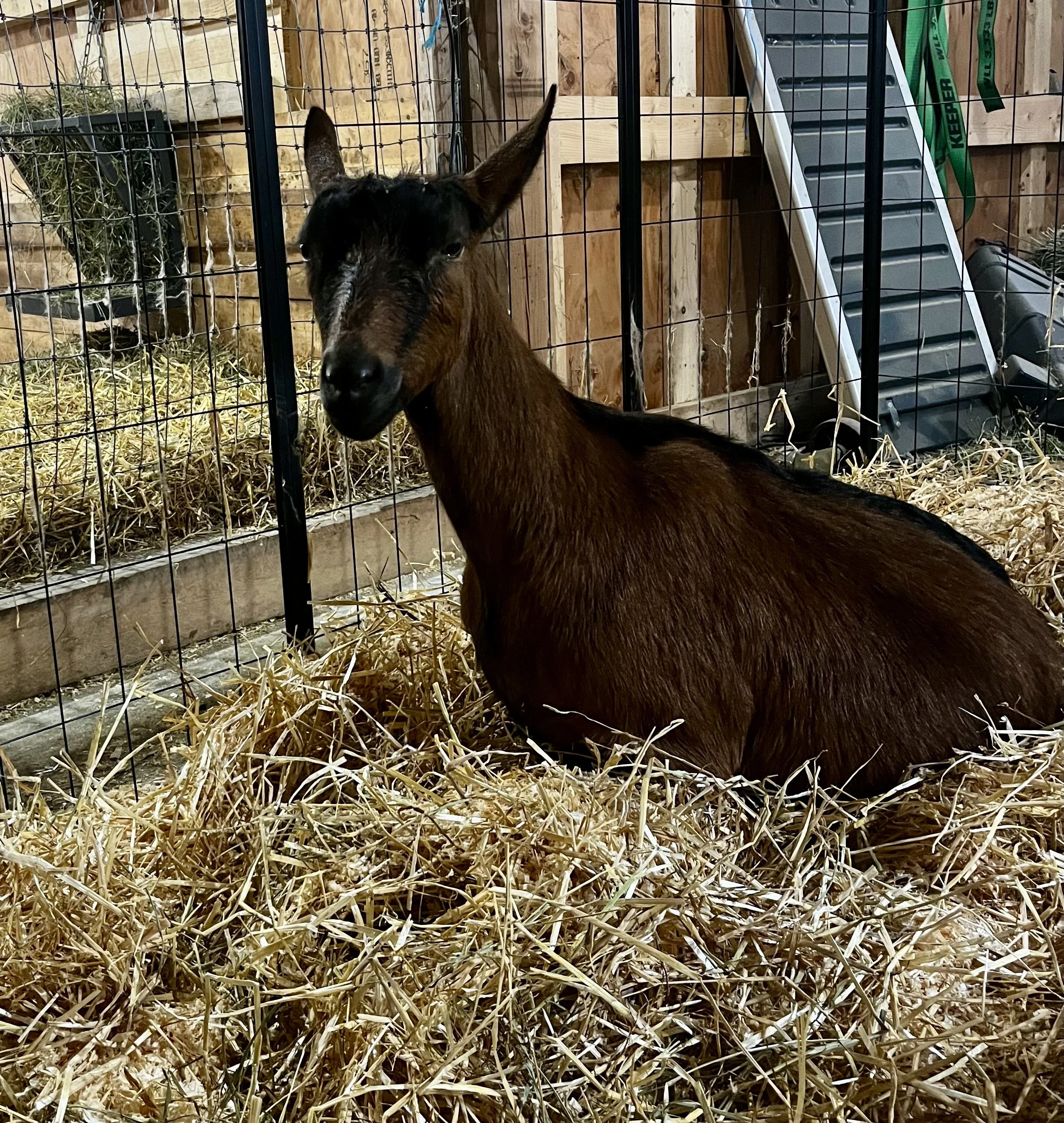
Manka, two hours into early labor
I didn’t plan to prep the kidding kennel for Manka, our Oberhasli doe that’s currently 148 days pregnant, until tomorrow. But something in her demeanor this morning signaled to me that now might be a good time to bed her private space down with fresh shavings and straw and scrub out her heated water bucket. We’re also supposed to get yet more snow this afternoon, so I decided to follow my gut. Not an hour after getting her into her maternity ward did she start showing her strongest signs yet that kidding is imminent. She’s been pawing her shavings and straw into piles, bleating her signature barely audible bleats, showering me with affection when I sat with her and pet her inside the kennel (I’m glad we chose one that’s just as tall as I am, as she seems to prefer me being near her and offering scratches, at least at this stage). A couple of yawns, some cloudy thick discharge peeking out from the birth canal. It would be nice if she kidded anytime before we’re supposed to slide back into single digits Sunday night.
We got Manka a couple of days after she kidded for the first time last spring. The breeder retained her two doe kids, so this will be her first time raising babies. Her udder already looks fuller than it did at her fullest as a first freshener. I’m watching her dig, settle, and stand on repeat on the baby monitor from inside the house, now. I have a feeling I won’t be sleeping much tonight.
The question on my mind is, of course, when she’s going to kid. A lot of goat breeders on the internet this season have been joking about when their does will “release the hostages,” or otherwise decide to give birth. No matter how you phrase it, the basic assumption behind the rhetoric of birthing—that the doe, or her body, decides when to press “eject”—leaves out a big part of the science behind giving birth.
I first got a glimpse into this when reading Origins: How the Nine Months Before Birth Shape the Rest of Our Lives by Annie Murphy Paul over the winter. This is the kind of book that’s so perfect, if I’d written it I’d consider my life’s work complete. In one of the later chapters, Paul seemingly takes a departure from her project of demonstrating maternal influence on fetal programming to examine the reciprocal relationship of mother and fetus in utero. She describes studies that show fetal activity affecting the mother’s physiology, a theme that cropped up in my studies few weeks later.
A textbook I’m studying, Clinical Anatomy and Physiology for Veterinary Technicians by Thomas Colville and Joanna Bassert, acknowledges that “precisely what triggers parturition is not known.” This surprised me, though it probably shouldn’t after reading Paul’s account of the dearth of research on gestation and maternal health for human women, unfortunately aligned with prevailing disparities in women’s healthcare overall.
What we do know about the process, Colville and Bassert explain, is that “hormonal changes form a chain of events that leads to the onset of labor.” When we witness this chain of events as birth, it looks like the doe’s body more or less determines the process—the extent of dilation, the cadence of contractions—whether or not it it all goes the way we’d like. Here’s what made me stop and realize how much of that picture is illusion: not only the placenta, but the fetus, contributes hormones that kick off the birth process: “The luteolytic prostaglandin F2alpha is released from the placenta and the uterine wall as a result of stimulation from increased levels of glucocorticoid hormones from the adrenal glands of the fetus. The prostaglandin also causes a rise in the dam’s estrogen level” (Colville and Bassert) [italics mine]. The fetus itself signals that it’s ready, and the doe’s body responds. A subtle shift in thinking about birth, but a total frameshift for me. As I let myself reimagine birth with this new knowledge, new questions arise. In a multiparous species, does one fetus’ adrenal glands start this signaling? All of them? Is this why stalled labor can result when one or more fetuses are dead? Is this “exit signal” preceded by other hormonal signals from fetus to doe during gestation? Does the doe’s physiology influence the fetus’ production of these glucocorticoid hormones—where do they truly originate?
If the fetuses are hostages, then perhaps we can kid that the hostages actually have a chemical Rube-Goldberg machine set up to execute their own release.